Black Tourmaline Meaning: The Boundary Stone, Honestly
The protection stone. It does not block wifi, and it does not need to.
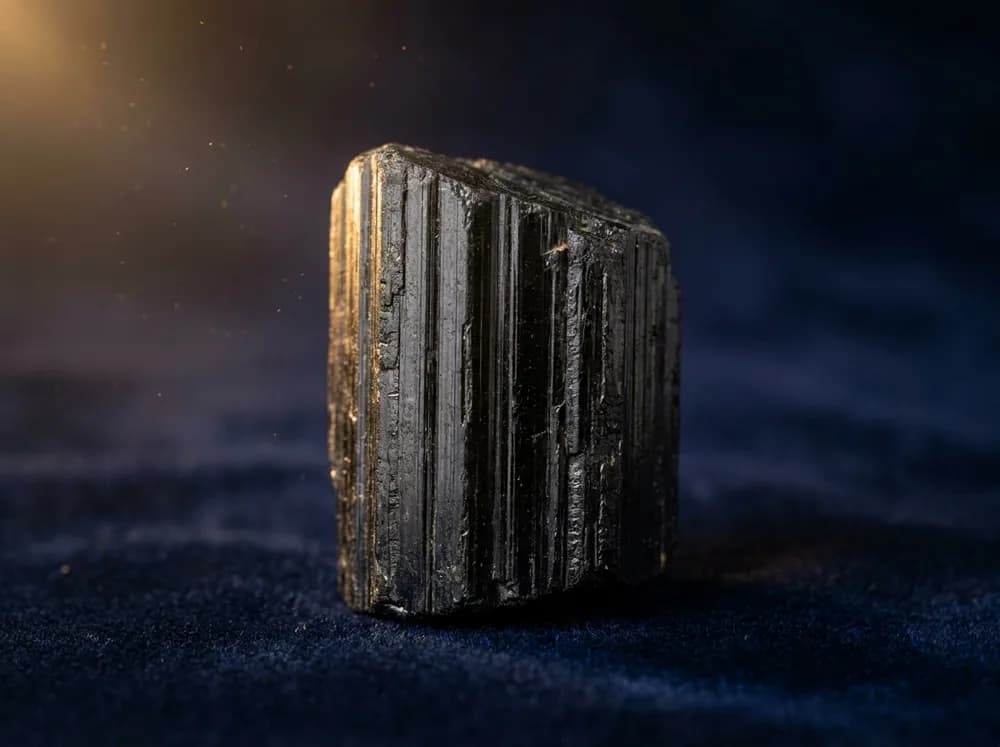
Black tourmaline is the stone people reach for when they need a boundary. By the front door, on the desk, in the bag before a difficult room. It is heavy, matte black, and grooved down its length like a bundle of rods.
At a glance
- Family
- Tourmaline. The black kind is called schorl
- Colour
- Deep black, often with vertical grooves
- Hardness
- 7 to 7.5 out of 10, hard but brittle along the grooves
- Water
- Brief rinse only. Do not soak
- Sunlight
- Safe, no colour to fade
- Mined in
- Brazil, Pakistan, Afghanistan, Madagascar, Maine
- Traditionally for
- Protection, grounding, boundaries
What black tourmaline means
Protection and grounding. In the tradition it is a boundary rather than a blessing, not a stone that brings something toward you, but one that is said to hold something off.
That distinction is why people put it by the door rather than on the altar. It is the stone of no rather than the stone of yes.
When to reach for it
- You are walking into a room with someone who drains you.
- You want a physical reminder to hold a boundary you keep dropping.
- Your home feels chaotic and you want to mark a threshold.
- You find it hard to say no and want something in your pocket that remembers for you.
How people use it
- By the front door, its most traditional placement by far.
- In a pocket, for a specific person or a specific meeting.
- On the desk, at the edge, where your eye lands.
- Held while you rehearse the sentence you find hard to say.
Where it comes from
Brazil, Pakistan and Afghanistan, Madagascar, Nigeria, and Maine and California. It grows in pegmatite, the same coarse rock that gives us rose quartz, which is why the two so often come from the same places. Tourmaline as a family is extraordinary. Its structure accepts an unusually wide range of elements, so it comes in nearly every colour there is. Iron makes it black, manganese makes it pink, and watermelon tourmaline is pink in the middle and green around the rim, all in one crystal.
Looking after it
- Water: a brief rinse is fine, but do not soak. Those grooves are lines of weakness and it splinters.
- Sunlight: safe.
- Knocks: brittle along the grooves.
Is it real?
- Real schorl is properly heavy for its size.
- It has fine grooves running down its length. Smooth, glassy black with no grooves may be glass or dyed stone.
- It scratches glass.
Frequently asked
Does black tourmaline block EMF?
No. There is no scientific basis for the claim that black tourmaline blocks EMF, wifi or phone radiation. It is a marketing claim. The stone does develop a small charge when heated or squeezed, which is why Dutch traders once called it the ash-puller, but that has nothing to do with shielding.
What does black tourmaline mean?
Black tourmaline is the stone of protection, grounding and boundaries. In the tradition it holds things off rather than draws things in, which is why it is placed by the door. These are traditional associations, not demonstrated effects.
Can black tourmaline go in water?
A brief rinse is fine, because it is hard at 7 to 7.5 out of 10. But do not soak it. The vertical grooves running down the crystal are lines of weakness, and it splinters along them.
Where does black tourmaline come from?
Brazil, Pakistan, Afghanistan, Madagascar, Nigeria, and Maine and California. It forms in pegmatite, the same rock that produces rose quartz.
Keep reading
Crystal Meanings: A Simple, Honest Guide to 12 Stones
What each stone means, when to reach for it, and how to look after it. Start here.
Which Crystals Cannot Go in Water? The Simple Rule
The rule is easier than the long lists suggest: if a stone is soft, keep it dry.
Amethyst Meaning: The Calm Stone, and How to Use It
The one most people own, and the one they reach for when their head will not switch off.