Lapis Lazuli Meaning: The Blue That Cost More Than Gold
One valley in Afghanistan supplied the whole ancient world, and the blue on Renaissance madonnas.
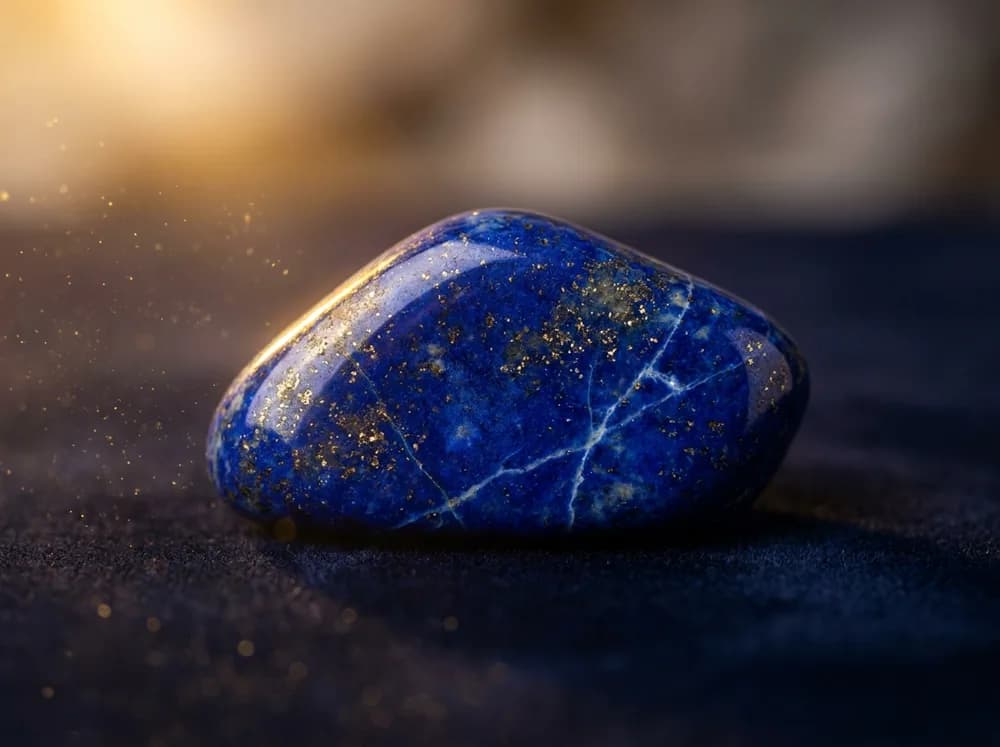
Lapis is the deep blue one with gold flecks in it, and it has the best history of any stone on this page. The flecks are not gold, it is not one mineral, and for most of human history it came out of a single remote valley.
At a glance
- Family
- A rock, not a single mineral
- Colour
- Deep royal blue with gold flecks
- Hardness
- 5 to 5.5 out of 10, soft-ish
- Water
- Brief only. Do not soak
- Sunlight
- Safe
- Mined in
- Afghanistan, for 6,000 years, and Chile
- Traditionally for
- Truth, speaking honestly, the throat
What lapis lazuli means
Truth, and saying it. It is the stone of honest speech, linked to the throat chakra, and it has been the stone of royalty and priests across the ancient world, worn by people whose words carried weight.
That association has been remarkably durable across thousands of years and completely unconnected cultures. In practice it is the stone for the thing you have been avoiding saying.
When to reach for it
- There is a conversation you keep not having.
- You are about to speak up and would rather not lose your nerve.
- You are writing something true and difficult.
- You have been performing agreement you do not feel.
How people use it
- Worn at the throat, the traditional placement, and no coincidence.
- Held while you rehearse the sentence.
- On the desk while you write the message.
- Carried on a day you know you will have to say it.
Where it comes from
Almost all the great lapis in history came from one place, the Sar-e-Sang mines in a valley in north-eastern Afghanistan. They have been worked for over six thousand years, which makes them among the oldest mines on earth still running. From that one valley, lapis travelled almost unbelievably far. It is in the royal tombs of Ur, it is inlaid in Tutankhamun's funeral mask, and it reached the Indus Valley. Chile and Russia produce lapis too, but Afghan stone has been the benchmark since the Bronze Age.
Looking after it
- Water: brief only. It is soft, and it contains minerals that react to water and acid.
- Handling: it scratches. Keep it off your keys.
- Sunlight: safe.
Is it real?
- Real lapis has uneven, scattered gold flecks and natural variation in the blue.
- Perfectly even navy at a low price is dyed jasper, which is extremely common.
- Reconstituted lapis is powder glued back together. It looks too consistent and feels light.
Frequently asked
What does lapis lazuli mean?
Lapis is the stone of truth and honest speech, linked to the throat chakra. It was a royal and priestly stone across the ancient world, worn by people whose words carried weight. These are traditional associations, not demonstrated effects.
Is lapis lazuli a crystal?
No, it is a rock rather than a single mineral. The deep blue comes from lazurite, the gold flecks are pyrite rather than gold, and the white marbling is calcite. The finest pieces are mostly lazurite with a scattering of pyrite.
Where does lapis lazuli come from?
Overwhelmingly from the Sar-e-Sang mines in north-eastern Afghanistan, worked for over six thousand years, among the oldest mines on earth. Chile also produces it, but Afghan lapis has been the benchmark since the Bronze Age.
Why was ultramarine more expensive than gold?
Ultramarine was made by grinding lapis, which came almost entirely from one remote Afghan valley and had to cross the known world. That scarcity priced it above gold by weight, which is why Renaissance painters saved it for the Virgin's robe. Synthetic ultramarine arrived in 1826 and the price collapsed.
Keep reading
Crystal Meanings: A Simple, Honest Guide to 12 Stones
What each stone means, when to reach for it, and how to look after it. Start here.
Which Crystals Cannot Go in Water? The Simple Rule
The rule is easier than the long lists suggest: if a stone is soft, keep it dry.
Amethyst Meaning: The Calm Stone, and How to Use It
The one most people own, and the one they reach for when their head will not switch off.