Obsidian Meaning: The Mirror Stone That Isn't a Crystal
It is not a crystal. It is frozen lava, and it has been a mirror for thousands of years.
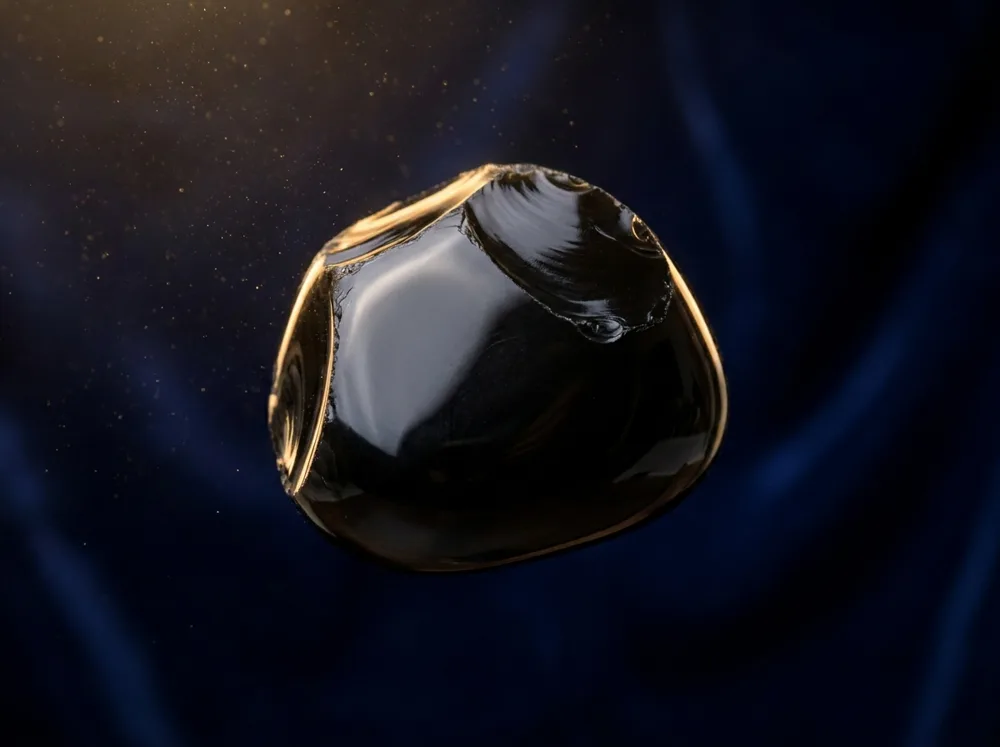
Obsidian is lava that cooled so fast it never had time to organise itself into a crystal. That makes it glass, technically not a crystal, and not even a mineral. It sits in every crystal shop anyway, and it has one of the best stories in the case.
At a glance
- Family
- None. It is volcanic glass, not a mineral
- Colour
- Glossy jet black
- Hardness
- 5 to 5.5 out of 10, and it chips
- Water
- Brief rinse fine
- Sunlight
- Safe
- Mined in
- Iceland, Mexico, Oregon, Italy, Armenia
- Traditionally for
- Truth, protection, facing things
What obsidian means
Truth, protection, and looking at what you would rather not look at. It is the mirror stone, and that is not a metaphor someone invented recently. Polished obsidian was an actual mirror for thousands of years, long before we could make them from glass.
The British Museum has John Dee's obsidian mirror, an Aztec piece that ended up in the hands of Queen Elizabeth I's astrologer, who used it to see things. The modern meaning grew straight out of the object.
When to reach for it
- You are avoiding a truth about yourself and you know it.
- You want a hard boundary rather than a soft one.
- You are grieving and want something solid rather than something pretty.
- You want to sit with a hard question instead of running from it.
How people use it
- As a scrying mirror, if you like. That is its oldest use, and the polished discs sold today are the same idea.
- In your hand while you ask yourself an honest question.
- By the door, like black tourmaline, as a boundary.
- On a shelf, where its reflection catches you unexpectedly.
Where it comes from
Only from young volcanoes, because glass does not last. Over millions of years it slowly turns into ordinary rock, so there is essentially no obsidian on earth older than about twenty million years, which is young in geology. It comes from Iceland, Oregon, California, Mexico, Lipari in Italy, Turkey and Armenia. Because each volcano's glass has a distinct chemical signature, archaeologists can trace a blade found hundreds of miles away back to the exact mountain it came from, which is how we know about trade routes from the Stone Age.
Looking after it
- Water: a brief rinse is fine.
- Handling: it is glass. It chips, and a fresh chip is genuinely sharp.
- Sunlight: safe.
Is it real?
- Real obsidian is glassy and does not stay cold the way quartz does.
- It breaks in smooth curved shells rather than flat faces.
- Snowflake obsidian has grey patches where the glass slowly began to crystallise after all.
Frequently asked
Is obsidian a crystal?
No. Obsidian is volcanic glass, lava that cooled too fast for its atoms to line up into the repeating pattern that defines a crystal. It is not technically a mineral either. It is sold as a crystal out of habit, not accuracy.
What does obsidian mean?
Obsidian is the stone of truth and protection, and it is known as the mirror stone. Polished obsidian served as a real mirror and a scrying surface for millennia, and the British Museum holds John Dee's Aztec obsidian mirror. The modern meaning is about facing what you would rather avoid.
Is obsidian really sharper than a scalpel?
A knapped obsidian edge can be a few molecules thick, finer than honed surgical steel. Because it has no crystal structure, it fractures in smooth curves that produce an extremely fine edge. Humans have made blades from it for tens of thousands of years.
Where does obsidian come from?
Only from geologically young volcanic areas: Iceland, Oregon, California, Mexico, Lipari in Italy, Turkey and Armenia. Volcanic glass slowly turns into ordinary rock over time, so almost no obsidian is older than about twenty million years.
Keep reading
Crystal Meanings: A Simple, Honest Guide to 12 Stones
What each stone means, when to reach for it, and how to look after it. Start here.
Which Crystals Cannot Go in Water? The Simple Rule
The rule is easier than the long lists suggest: if a stone is soft, keep it dry.
Amethyst Meaning: The Calm Stone, and How to Use It
The one most people own, and the one they reach for when their head will not switch off.