Selenite Meaning: The Stone People Destroy by Accident
Never put it in water. More selenite is destroyed by cleansing than by clumsiness.
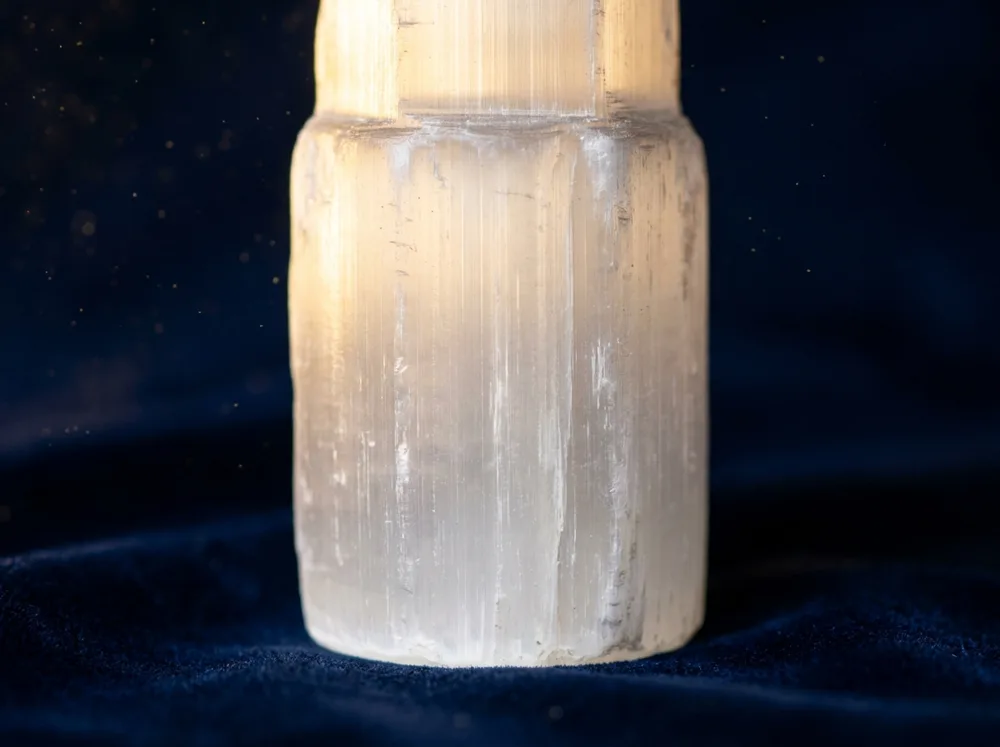
Start with the warning, because this is the stone people ruin. Selenite dissolves in water. Not chips, not dulls, dissolves. A selenite tower rinsed under the tap goes cloudy, then chalky, then it is gone. And because it is famous as the cleansing stone, people rinse it. That is the whole tragedy.
At a glance
- Family
- Gypsum
- Colour
- White, pearly, silky
- Hardness
- 2 out of 10, you can scratch it with a fingernail
- Water
- Never. It genuinely dissolves
- Sunlight
- Safe
- Mined in
- Morocco, Mexico, Oklahoma, Poland
- Traditionally for
- Clearing, light, cleansing other stones
What selenite means
Clearing and light. It is named after Selene, the Greek goddess of the moon, for the way it catches light like moonlight on water.
It has an unusual job in modern practice. It is the stone said to cleanse other stones, so people rest their crystals on a selenite plate overnight. Which is convenient, given selenite is the one stone you must never rinse.
When to reach for it
- You want a simple, dry way to reset your other crystals.
- You want something luminous on a shelf without fuss.
- You are clearing a space, moving house, ending something, starting again.
How people use it
- As a plate or slab, with your other stones resting on it. This is its main modern use.
- On a windowsill or shelf where it catches light. Sunlight will not hurt it.
- Held during a moment you want to mark as a clean start.
Where it comes from
Most of the silky white towers on the market come from Morocco. It also comes from Mexico, Poland, and Oklahoma, where you can go and dig your own. It forms by evaporation, left behind when mineral-rich water dries out, which is exactly why water takes it back. The most astonishing selenite on earth is in the Cave of the Crystals at Naica in Mexico, where gypsum beams over eleven metres long grew in mineral-saturated water. The cave is so hot and humid that people can only survive inside it for minutes.
Looking after it
- Water: never. Not a rinse, not a damp cloth, not a humid bathroom if you can help it.
- Handling: it scratches on almost anything, including your fingernail. Keep it away from harder stones.
- Cleansing it: dry methods only, moonlight, smoke, sound.
Is it real?
- Real selenite is startlingly light for its size.
- It has a fibrous, silky look, like the grain in a piece of satin.
- Your fingernail will mark it. Nothing else on this page is that soft.
Frequently asked
Can selenite go in water?
No, never. Selenite is gypsum and it genuinely dissolves. Rinsing turns it cloudy, then chalky, then it disintegrates, and even a damp cloth causes damage. Use dry cleansing methods only: moonlight, smoke, or sound.
What does selenite mean?
Selenite is the stone of clearing and light, named after Selene, the Greek goddess of the moon. In modern practice it is the stone used to cleanse other crystals, which is why people rest their stones on a selenite plate. These are traditional associations, not demonstrated effects.
How soft is selenite?
It is a 2 out of 10 on the hardness scale, soft enough to scratch with a fingernail. It is by far the softest stone commonly sold, so keep it away from harder crystals that will mark it.
What is satin spar?
Satin spar is the fibrous, silky, pearlescent form of gypsum that most selenite wands and towers are actually made from. True selenite is the clear, glassy form. The trade uses the two names interchangeably.
Keep reading
Crystal Meanings: A Simple, Honest Guide to 12 Stones
What each stone means, when to reach for it, and how to look after it. Start here.
Which Crystals Cannot Go in Water? The Simple Rule
The rule is easier than the long lists suggest: if a stone is soft, keep it dry.
Amethyst Meaning: The Calm Stone, and How to Use It
The one most people own, and the one they reach for when their head will not switch off.