Tiger's Eye Meaning: The Stone With Light Rolling Across It
A band of light that rolls across the stone like sheen on silk, and it used to be something else entirely.
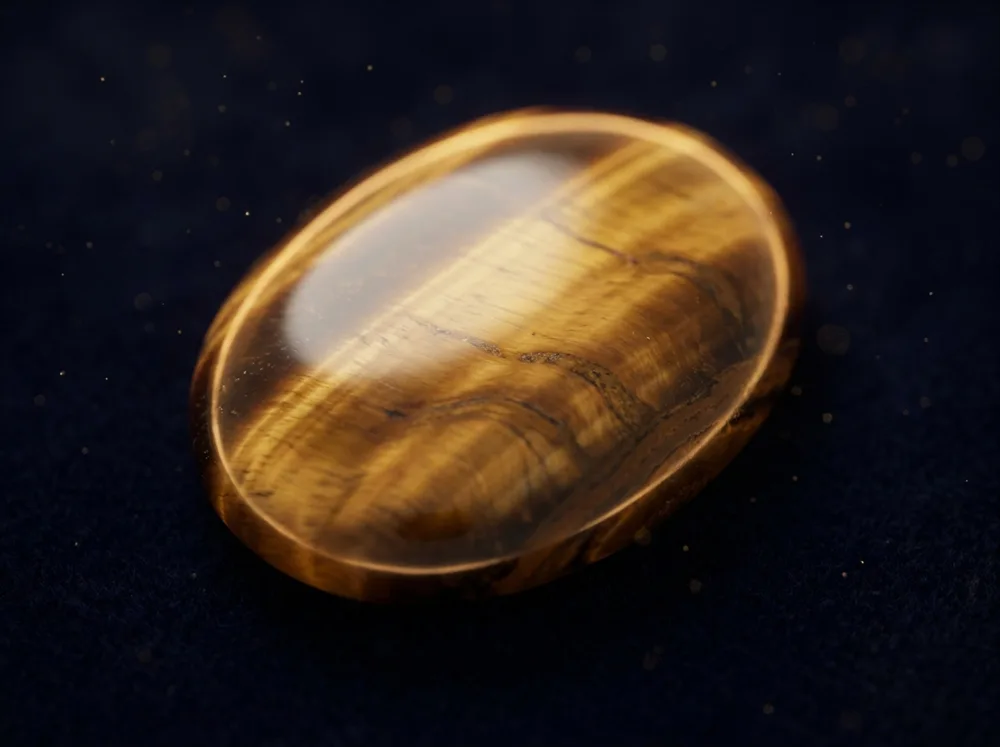
Tiger's eye has a band of light that rolls across it as you turn it, like the sheen moving on a spool of silk. It is the stone people carry when they need to hold their nerve rather than dream a dream.
At a glance
- Family
- Quartz, but it grew into something else's shape
- Colour
- Golden brown, honey, with a moving sheen
- Hardness
- 7 out of 10, tough
- Water
- Safe
- Sunlight
- Dulls the gold over time
- Mined in
- South Africa, Australia, Namibia
- Traditionally for
- Courage, focus, steady nerve
What tiger's eye means
Courage, focus, and steady confidence. Not the loud kind, the kind that gets you through the meeting. Roman soldiers are said to have carried it into battle. It is linked to the solar plexus.
In the tradition it is a practical, working stone rather than a mystical one. Which suits it, because this is quartz doing an impression of something else, and getting on with it.
When to reach for it
- You are nervous about something you have already decided to do.
- You need to hold your nerve for an hour, not find your purpose.
- You are being underestimated and would rather not react.
- You have to walk into a room and be steady.
How people use it
- In a pocket, thumb moving over it, before the thing you are dreading.
- On the desk during the work that requires nerve.
- Carried on interview or presentation days. This is its most common modern use.
- Held while you decide to go ahead anyway.
Where it comes from
South Africa above all. The Northern Cape, around Griquatown, is the classic source and still dominates. Western Australia, Namibia, India and Brazil produce it too. Its history is the strange part. It began as a completely different mineral, a fibrous blue one, and over enormous time silica-rich water crept through and replaced those fibres with quartz, but the quartz grew into their arrangement and kept the threads. Iron rusted during the process, which is what turned the blue to gold. Blue tiger's eye, called hawk's eye, is the same stone that did not finish rusting.
Looking after it
- Water: safe.
- Sunlight: dulls the gold over long exposure. Shelf, not windowsill.
- Knocks: it is hard, and forgiving.
Is it real?
- The band of light should move as you turn the stone. If the sheen sits still, it is fake.
- Dyed red and blue tiger's eye is common and usually obvious from how loud it is.
- It should feel cold and heavy.
Frequently asked
What does tiger's eye mean?
Tiger's eye is the stone of courage, focus and steady confidence, the practical working kind rather than the mystical kind. Roman soldiers are said to have carried it into battle, and it is linked to the solar plexus. These are traditional associations, not demonstrated effects.
Is tiger's eye asbestos or dangerous?
Finished tiger's eye is completely safe to own, hold and wear. It grew from crocidolite, which is blue asbestos, but the fibres have been replaced by quartz and locked into solid stone. The only hazard is dust, so never grind, sand or cut any stone dry at home.
Why does tiger's eye shimmer?
It began as a fibrous mineral, and quartz gradually replaced those fibres while keeping their parallel arrangement. Light reflecting off all those aligned threads concentrates into a single band that rolls across the stone as you turn it. The effect is called chatoyancy, from the French for cat's eye.
Where does tiger's eye come from?
South Africa's Northern Cape, around Griquatown, is the classic and dominant source. Western Australia, Namibia, India and Brazil also produce it.
Keep reading
Crystal Meanings: A Simple, Honest Guide to 12 Stones
What each stone means, when to reach for it, and how to look after it. Start here.
Which Crystals Cannot Go in Water? The Simple Rule
The rule is easier than the long lists suggest: if a stone is soft, keep it dry.
Amethyst Meaning: The Calm Stone, and How to Use It
The one most people own, and the one they reach for when their head will not switch off.